Automation games look similar from a distance: resources go in, products come out, the factory grows. But the way a game moves items changes everything. Belts, bots, and trains are not just transport tools. They are different design languages.
Once you understand the three styles, it becomes easier to explain why Factorio feels different from Satisfactory, why shapez 2 feels so clean, and why a train network can turn a factory from a workshop into a continent-scale system.
The short version
| Style | Feels like | Best at | Weakness |
|---|---|---|---|
| Belts | A visible river of items | Readable local production and bottleneck hunting | Can become tangled at scale |
| Bots | A flexible swarm of errands | Short routes, repairs, construction, late-game flexibility | Can hide the logic of the factory |
| Trains | A scheduled cargo network | Long-distance throughput, outposts, city blocks, bulk movement | Needs planning, stations, buffers, and signals |
Belts: the factory you can read
Belts are the most iconic automation tool because they make the factory visible. You can look at a belt and understand what is happening: iron plates are moving here, circuits are backing up there, copper is starving that assembler, science is blocked by one missing input.
This is why belt-based games feel so satisfying early on. The machine is not hidden behind menus. It is right there on the floor, making its mistakes in public.
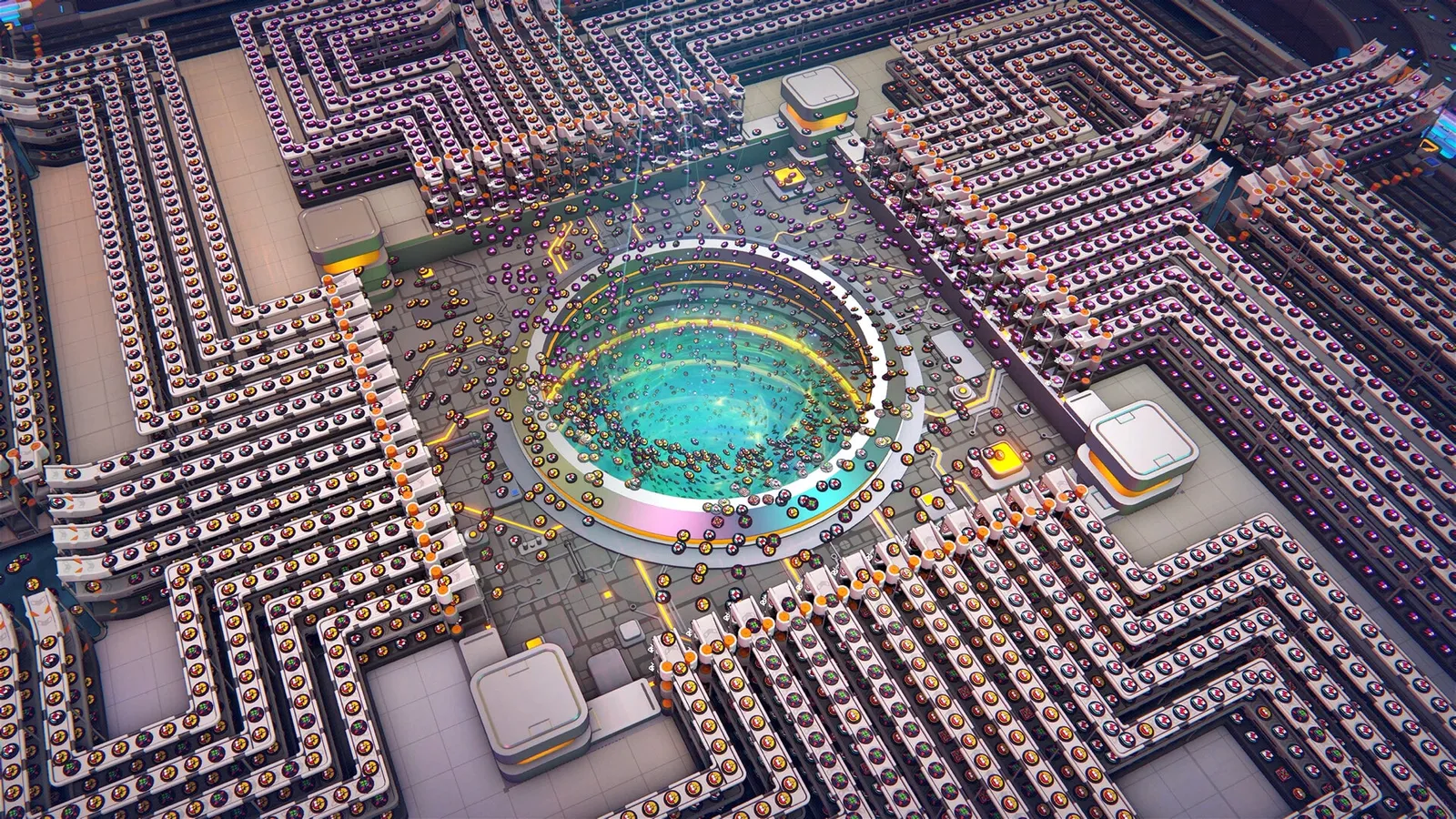
Belts are strongest when production is local. A miner feeds a smelter. A smelter feeds an assembler. A small group of machines becomes a module. The player can see the flow and improve it.
The weakness arrives when scale grows faster than structure. A factory can become a knot of spaghetti, and sometimes the knot is charming. Sometimes it is a warning.
Bots: the factory that delegates
Bots change the feel of automation because they remove some of the visible routing. Instead of drawing every path with belts, you give a job to a helper: fetch this, deliver that, repair this wall, build this blueprint, keep this chest stocked.
In Factorio, logistic and construction robots are powerful because they make the factory more flexible. In Autonauts, the whole game is built around teaching workers. In Desynced, units and behaviors become the factory's logic layer.
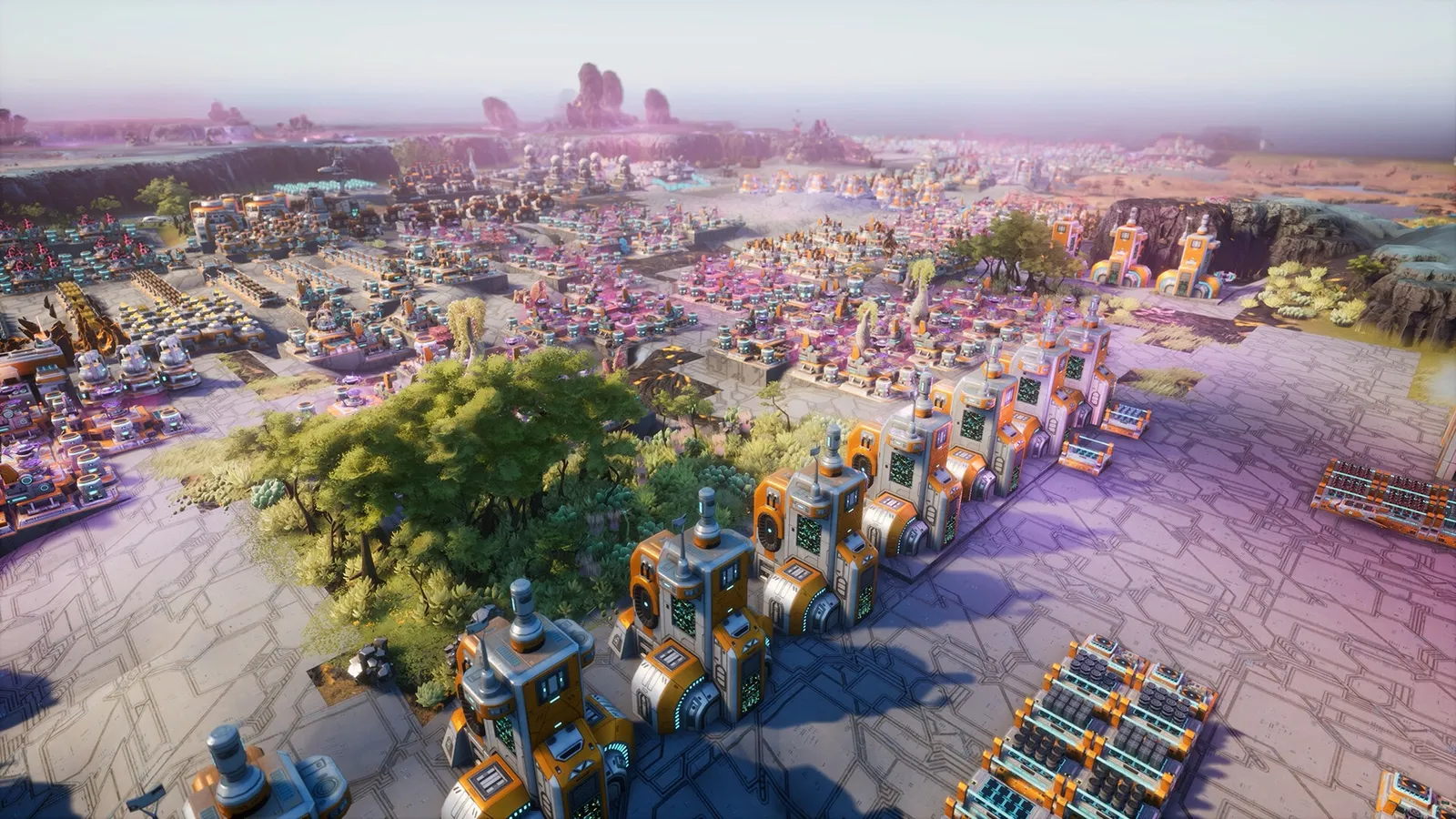
Bots are excellent for messy, variable, short-range tasks. They repair, rebuild, top up buffers, handle awkward recipes, and reduce the pain of rearranging a base. They make the factory feel alive.
The tradeoff is readability. A belt shows you the problem. A bot network can hide it until the battery drains, the storage fills, or half the swarm flies across the map to move one low-value item.
Trains: the factory becomes a map
Trains are the moment many automation games stop being about one factory floor and start being about territory. A train does not solve a local recipe. It connects sites: ore outposts, oil fields, science districts, power plants, defensive walls, city blocks, and storage yards.
That is why train logistics feels different. You are no longer asking, "Can this belt move enough iron?" You are asking, "Where should iron enter the network, where should it wait, and what happens when three trains want the same junction?"
Good train systems need stations, buffers, signals, stackers, naming conventions, and room to grow. They are more work than belts at first, but they pay back that work by making distance manageable.
Why the mix matters
The strongest factory games rarely choose only one style. They combine them. Belts handle precise local production. Bots smooth awkward edges. Trains move bulk goods between districts. Drones or vehicles fill special cases.
Dyson Sphere Program shows another version of the same idea: belts handle local production, then logistics stations move resources between planets. The principle is the same even when the vehicle changes. Local flow and long-distance flow are different problems.
How to choose a logistics style
If you enjoy seeing every item move, lean toward belt-heavy games like shapez 2, Factorio, and Beltmatic. If you like delegation and programming, look at Autonauts, Desynced, or Craftomation 101. If you love networks, stations, and routing, trains are the rabbit hole.
The real lesson is simple: transport is not a supporting feature in automation games. Transport is the game. Recipes create demand, but logistics decides whether the factory can actually breathe.
Related reads: When Belts Stop Being Enough, Main Bus vs Modular Factories, and Best Train Logistics Games.