The main bus is one of the most famous factory layouts because it gives early chaos a spine. Put common materials on long shared belts, pull resources off the side, build production blocks next to the bus, and suddenly the factory looks like it has a plan.
Modular factories solve a different problem. Instead of one central river of materials, you build independent production cells: green circuits here, engines there, science somewhere else, each with its own inputs, outputs, and expansion logic.
The short version
| Layout | Best at | Starts to struggle when |
|---|---|---|
| Main bus | Learning, early organization, shared resources, readable growth | The factory gets too wide, too hungry, or too specialized |
| Modular factory | Scaling, repeatable blocks, train bases, specialization, cleaner upgrades | You have not planned inputs, outputs, or logistics between modules |
What a main bus does well
In Factorio, a main bus is popular because it reduces early decision fatigue. Iron plates go here. Copper plates go there. Circuits, gears, steel, and other common inputs get their own lanes. Machines pull what they need from the side.
That makes the factory easier to read. If a science build is starving, you can trace the missing input back to the bus. If the bus is empty, you know the problem is upstream. For a learning player, that clarity is gold.
The bus also teaches good habits: leave room, route inputs cleanly, separate production blocks, and think about shared demand instead of solving every recipe as a one-off mess.
Where the main bus gets awkward
The main bus starts to struggle when every product wants more than the bus can comfortably provide. More belts get added. More lanes get reserved. More production blocks pull from the same stream. Eventually the bus becomes a monument to decisions you made ten hours ago.
The problem is not that the bus is bad. The problem is that it is a transitional structure. It is wonderful for getting organized. It is not always the cleanest way to build a late-game factory.
What modular factories do differently
Modular factories treat each production chain as a unit. Instead of one long shared resource river, you build a module that takes defined inputs and produces defined outputs. The module can be copied, expanded, moved, fed by trains, or replaced by a better version.
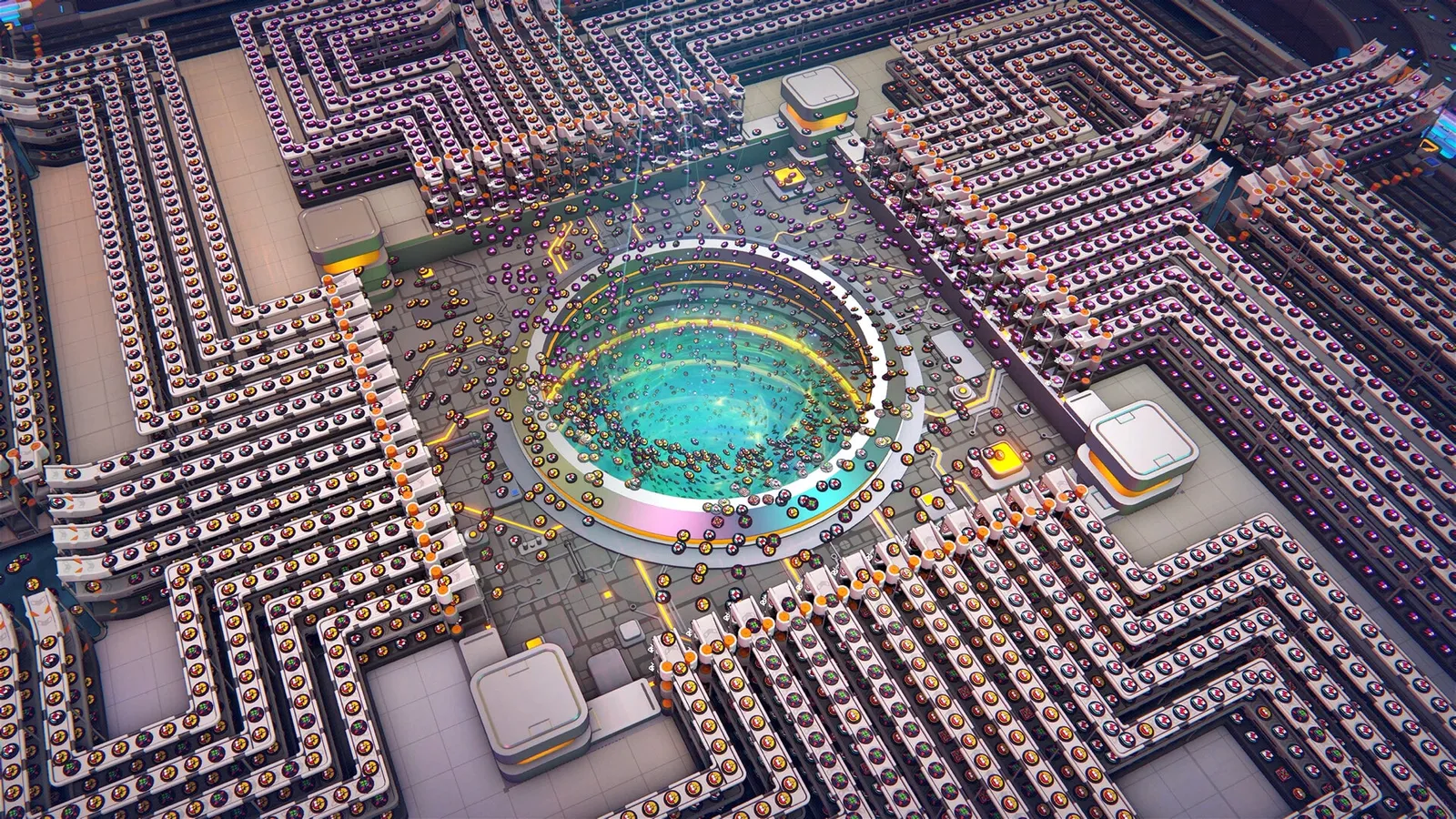
This style fits games where blueprints, trains, drones, or platforms make repeated blocks practical. Factorio city blocks are one version. shapez 2 shape-processing blocks are another. Satisfactory production floors often become modular by necessity because space is vertical and physical.
The hidden cost of modular design
Modular factories look cleaner once they work, but they ask for more planning. What does the module consume? What does it output? How many copies will you need? Is the input delivered by belt, train, drone, or local production? Where does overflow go?
A bad module can be worse than spaghetti because it looks organized while hiding a bad assumption. If the input math is wrong, every copy repeats the mistake.
When to use each style
Use a main bus when you are learning a game, building your first stable science chain, or trying to keep early production readable. It is especially useful before trains, blueprints, or high-throughput logistics take over.
Use modular factories when recipes get specialized, demand grows sharply, or long-distance logistics becomes the real problem. A module is easier to scale, replace, and reason about once the factory is too large for one shared backbone.
The better question
The real question is not "main bus or modular?" It is "what is the factory's current job?" Early factories need clarity. Mid-game factories need throughput. Late-game factories need repeatable structure.
A good main bus gets you out of chaos. Good modules keep you from returning to it.
Related reads: Belts, Bots, Trains, When Belts Stop Being Enough, and shapez 2 vs Factorio.